
Lesson 1a
Stories of societies which succeeded or collapsed
Sustainable development deals with the long-term prosperity or collapse of societies. Why is this a concern for us? The societies and countries we live in have a long history, thousands of years. Should we expect a collapse in the near future? Nevertheless, it is a threat that many are concerned with when it comes to the global society, all countries in the world. Collapse then does not mean eradication, but rather that there will be fundamental changes in the way things work. The reasons are that basic resources for us are coming to an end. Thus, fossil fuels, coal, oil and gas, become more difficult to find and prices are mounting. The so called “peak-oil”, the time of maximum production, has already passed for conventional oil and the peak approaches rapidly for other kind of fossil resources. At the same time the climate change caused mostly by the human combustion of fossil carbon and its consequences – disasters, such as storms, floods, and draughts and a melting arctic ice – aggravate. We also see declining or collapsing fish stocks, biodiversity decline and deforestation, and an increasing population on the planet. Will there be enough food for everyone? A basic requirement for today’s agriculture – production of phosphorous – is also rapidly emptied.
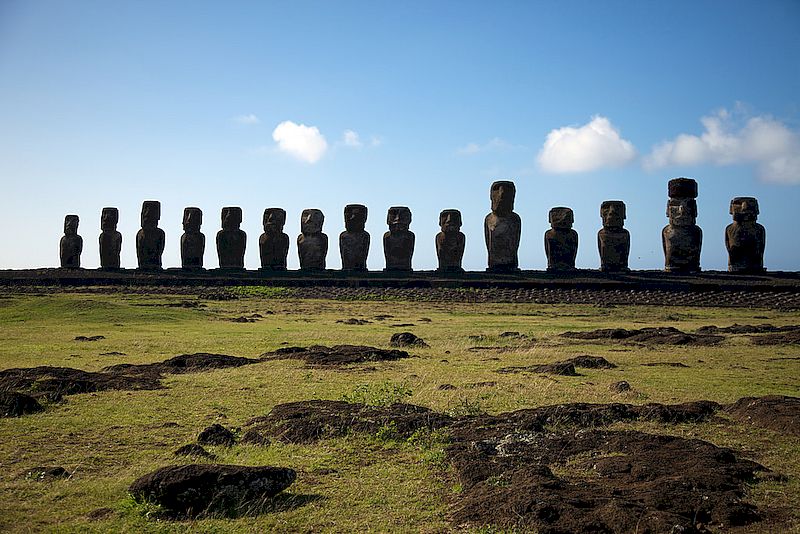
The concern for sustainable development is thus caused by questioning the continued successful development. Will we succeed or collapse? It is not difficult to find examples of societies which collapsed. The best known may be Easter Island. Easter Island is a small island in the vast expense of the Pacific outside the coast of Chile. It is known for its enormously large statues of human heads made of stone. When western seafarers “discovered” the island (on Easter day) in the 18th century, there was only a small group of people living in terrible conditions in a barren landscape. The stone heads witnessed about a once flowering society, which now had collapsed. An important reason of the collapse of the society was apparently the loss of the forest. The absence of trees made it impossible to build boats or canoes to fish, or to build decent houses.
The American geographer and physiologist Jared Diamond in his book “Collapse – how societies choose to fail or succeed” analyses a dozen societies, including the Easter Island, which failed, most of them ancient but some contemporary. He does not blame individuals, for example the person who cut down the last tree on Easter Island, but looks for developments in the societies. It is clear that they have a few things in common. On top of the list of causes of collapse are environmental impacts, in particular deforestation and destruction of soil.
In today’s discussion on sustainable development, deforestation is still a concern. Deforestation is driving climate change and is a main cause of biodiversity loss. It is included in the global negotiations on climate change under the title REDD, Reducing Emissions from Deforestation and forest Degradation. It is today mostly a question for the Southern Hemisphere, the tropical forests, but also in our societies we had a deforestation crisis, but in the 18th century. The forests were becoming clear-cut due to the large consumption of wood. It is interesting to note how the “crisis” was managed and avoided then; it is relevant for how we do today. The dealing with the European forest crisis led to the introduction of the term “Sustainability” for the very first time.
Our development has lead to societies in which most people have better, longer and healthier lives than earlier generations, but it had a price. Today’s concern for sustainable development is not in the first place concerned with a specific country. Again, it is as a global society we over-use the resources of our planet. We cut down forest, we over-fish the oceans, we use more energy than the Earth can provide in the longer term; and the end products from human activities pollute the environment too much. If this continues at some point it will lead to collapse, just as was the case in many societies, which already collapsed. Understanding and knowing sustainable development is needed to avoid this and instead create a prosperous future for this and coming generations.
Materials for session 1a
Basic level
- Read the story of the Easter Island (pdf) by Sverker Sörlin.
- Watch the film with Sverker Sörlin on Easter Island (YouTube film).
- Read the European Forest Crisis (pdf) and the origin of the sustainability concept.
- See Jared Diamond introduce his book Collapse on collapsing societies (YouTube film).
Medium level (widening)
- View a presentation by Lars Rydén on: Climate Existence Seminar on Resources (pdf).
- Read Environmental Science, chapter 25, pages 767-771: The Prospect of Sustainable Development (pdf) or The Prospect of Sustainable Development (pdf) (in Russian)
- Study the Mayan deforestation and the consequent collapse of the Mayan society. Also study Mayan and modern farming in Central America.
Advanced level (deepening)
Study in some detail an example of change from collapse to prosperity:
- Paolo Lugari, founder of Las Gaviotas (YouTube film)
References
Diamond, J. 2005. Collapse – how societies choose to fail or succeed. Viking Books.
Rydén, L., Migula, P. and M. Andersson (eds). 2003. Environmental Science – understanding, protecting and managing the environment in the Baltic Sea region. Baltic University Press. Uppsala, Sweden.
Sörlin, S. 1997. The Story of Easter Island. In: A Sustainable Baltic Region 1. The road towards sustainability – a historical perspective. Baltic University Press. Uppsala, Sweden.