
Lesson 1d
What we believe in – Our values and sustainable development
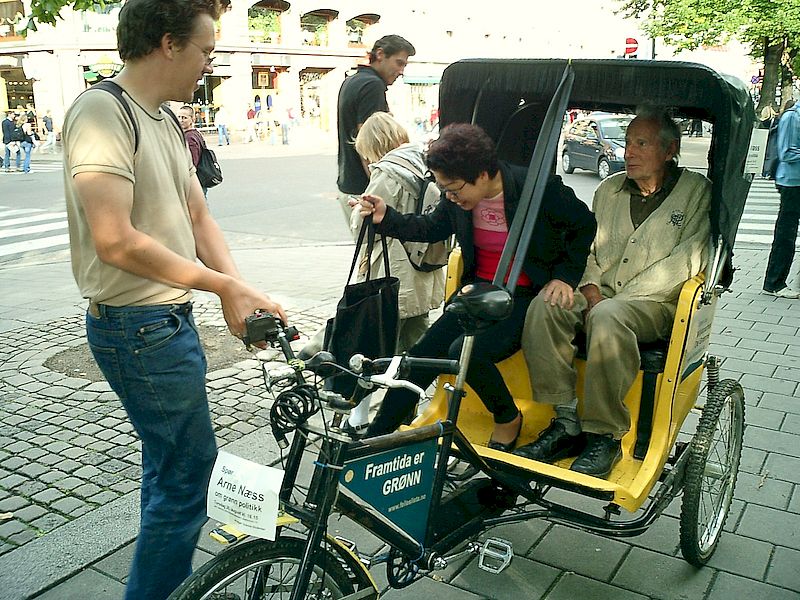
Professor Arne Næss founder of the deep ecology philosophy campaigning for the Norwegian Green party in 2003.
Sustainable development is not only a political and scientific concept. It is also a value. The Brundtland commission underlined that sustainability is an ethics for our future. In the 1987 report, they write: “We have attempted to demonstrate how human survival and well-being may be dependent on our capacity to successfully transform the principles behind sustainable development into global ethics.”
There are several parts in this ethics. The value dimension of sustainable development may be expressed in terms of justice.
Firstly, those who support, or work for, sustainable development with respect for the needs of coming generations. When we ask for justice between this and coming generations, we ask for intergenerational justice. The weak point with this request of justice is that the next generation is far away in time and space. This feeling of distance may be reduced by referring to the grandchildren, who already are here, or the fact that most people like the thought that what they have built up is preserved.
Sustainability is about sharing resources of our planet, not only between us and coming generations, but also between us living here and now. It is called intra-generational justice, justice between us here and now. The principle that each human being has the same right to resources is included in the Rio Declaration. For example, in the climate negotiations the long-term goal seems to be that the per capita emissions of carbon dioxide should then be the same everywhere. This is today very far from the reality, and the gap between the poor and the rich is increasing. The gross violation of this value is by many judged as the most serious of all threats to sustainable development.

A third ethical principle of Sustainability is our obligations towards other life forms of the world, the animals, the plants, and the Nature in general. This is called bio-centric ethics or justice. Other life forms may not have duties towards us, but we have it towards them. The World Conservations Strategy, published by IUCN (International Union for the Conservation of Nature) in 1980 alarmed us about the rapid loss of biodiversity. The extinction of a number of life forms each year was seen as not only a problem for sustainable development, but also an ethical problem. We as humans do not have the right to “extinguish” these other forms of life. To this ethical statement are added concerns for resources, for the beauty of our world and the value of the natural world for coming generations. (See also: Chapter 6a: The living world)
We see the role of ethics increasing in many contexts. Ethics motivate people to care for the world around them and change their lifestyles. Ethics is used to clarify the role of values in policy decisions and choosing among alternatives of action. In sustainable development, the role of values and ethics are often underlined. It needs to be transparent to help us to choose our future.
Materials for session 1d
Basic level
- Read relevant parts of Environmental Science, chapter 21, especially pages 635-645: Behaviour and the Environment – Ethics, Education, and Lifestyle (pdf).
- Watch an interview with Prof William Hatcher (YouTube film).
- Watch an interview with Erwin Lazlo (YouTube film).
Medium level (widening)
- Read chapters 1, 2 and 3 by Mikael Stenmark in: A Sustainable Baltic Region, Session 9: Foundations of Sustainable Development (pdf)
Advanced level (deepening)
- See the films and study the attached material on Global Responsibility (YouTube film).
- Study the Earth Charter Initiative and read the Charter as a development of ethics for sustainable living.
- Explore the concept of Gaia and deep ecology. Watch Dr. Stephan Harding – Part 1 / 10 – Gaia Theory & Deep Ecology (YouTube film).
References
Rydén, L., Migula, P. and M. Andersson (eds). 2003. Environmental Science – understanding, protecting and managing the environment in the Baltic Sea region. Baltic University Press. Uppsala, Sweden.
Stenmark. M. 1997. Foundations of Sustainable Development. In: A Sustainable Baltic Region. Session 9. Baltic University Press. Uppsala, Sweden.
BUP Sustainable Development Course