
lesson 7d
Policies and management of mobility
Mobility and transport are central in our societies and have large benefits but, at the same time, high environmental costs. To reduce these costs, without causing too great problems for large groups in our societies, is difficult. Nevertheless, it is necessary if we should approach a sustainable society. Some necessary measures seem fairly clear, as transport research points out. The combustion car has to be largely exchanged for the electric car. This will take time. The limited and expensive battery is the largest obstacle. We will also have to drive car less, especially in cities; an estimation for Stockholm is 15-30% less. This corresponds to car driving on 1985 level. It is not difficult to live in a city without a car when public transport and biking is working well. In Stockholm, half of the households do not have a car today. Transport has to move to train and boat, while sustainable air traffic is so far an unsolved dilemma.
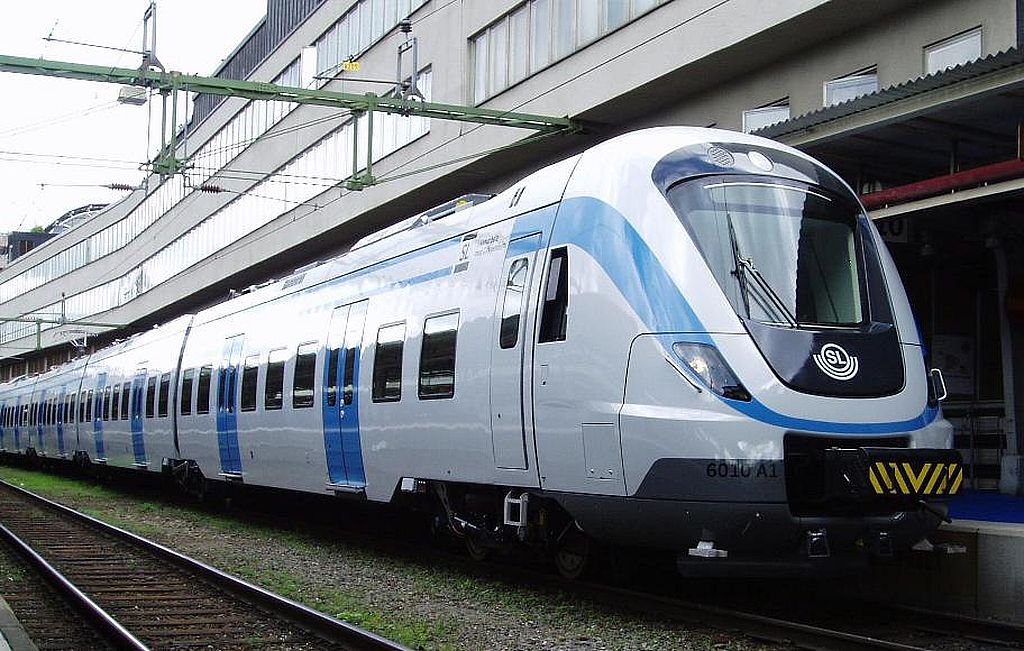
National transport polices exist in all countries, and also on the European level. Policies for transport may also have been taken in regional and local authorities, as well as by companies or organizations. These are however dependent on the actions taken on the national level, as the regulations and taxation belong to this level. The dilemma for policy actions is to balance the needs of transportation against the costs. An important part of the policies is to make more sustainable alternatives more attractive and the less sustainable alternatives less so. This may be done by supporting the more sustainable alternatives. On the national level, it is for example possible to invest in the development of train traffic or fast trains.
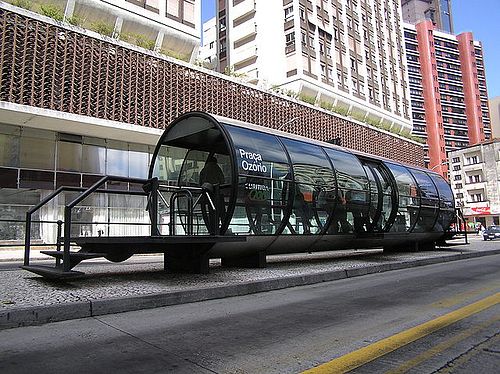
On the local and regional level, it is possible to support sustainable transport by good urban planning. The goal is to make a pleasant living environment and avoid traffic congestion, and decrease air pollution, noise and accidents. Investments in and development of public transport is important. Curitiba in Brazil became a symbol for good design of urban planning and public transport based on a clever fast-bus system. A culture and support of biking is efficient, illustrated by Amsterdam in the Netherlands. Car-free city centres or other car-free areas increase. A fee for entering the city centre by car has been introduced in e.g. London, Oslo, and Stockholm. Copenhagen has made car parking difficult and expensive. The introduction of such measures requires that local public transport works well.
Taxation of car driving is an important measure to reduce car traffic. The several taxes and charges used include tax when buying a car, tax for mileage, insurance costs and inspection costs. Most important is tax on fuel and carbon dioxide emissions. If tax on petrol is high, fuel-efficient cars will be more attractive. Taxation may be differential. Carbon dioxide taxation does not apply to renewable fuels, such as biogas, bioethanol or biodiesel, which increase the market for cars using such fuels. So-called green cars, mostly cars using renewable fuels, may be exempt from some taxation, such as entrance fees to city centres.
There are also regulations on cars and other forms of transportation. This includes safety measures such as speed limits, which also reduced emissions, which increase steeply with high speed. Within the EU, there is a maximum allowed level of carbon dioxide exhausts per kilometre of driving, at present 125 g/km. This figure will be reduced with time.
Mobility management is a management approach to making transport more sustainable. Mobility management is most often local and is centred at an information office in a city. The managers help individuals and also groups to find the best and the cheapest alternatives, e.g. for commuting. A Mobility Management Centre typically also runs projects. Here are some examples: organizing a biking schools for kids; negotiating an agreement between employed at a big hospital with the bus company for low price tickets; Restoration of an old railway to an industrial plant to avoid truck traffic in a city; Coordinating all transports to shops in city centre from a logistics central in the outskirts the city. Many Centres in the EU have joined the European Platform on Mobility Management, a European resource for Mobility Management.
Materials for session 7d
Basic level
- Read A Sustainable Baltic Region, session 6, chapter 7 (pdf): Economic Policy Instruments.
- Read Environmental Management, book 1, chapter 10 (pdf): Economic Policy Instruments — Taxes and Fees, especially Section 10.3 Environmental Taxes on pages 140-146.
- Read Bringing Quality to Life – The contribution of the public transport sector to sustainable development (more management).
Medium level (widening)
- Read A sustainable future for transport : Towards an integrated, technology-led and user-friendly system (EU Commission report)
- EPOMM is the European Platform on Mobility Management
- Read about the European Mobility Week campaign
Advanced level (deepening)
- Study a national l transport policy. This is for Ireland: A Sustainable Transport Future – A New Transport Policy for Ireland 2009-2020
- Policy Scenarios for Sustainable Mobility in Europe – the POSSUM Project
- Study how to organize a mobility management centres in the Mobility Management User Manual. Look for a centre in your own country.
References
European Commission. 2009. A sustainable future for transport — Towards an integrated, technology-led and user-friendly system. Publications Office of the European Union, Luxembourg.
Klemmensen, B., Pedersen, S., Dirckinck-Holmfeld, K.R., Marklund, A. and L. Rydén. 2007. Environmental Policy – Legal and Economic Instruments. Environmental Management Book 1, Baltic University Press, Uppsala.
Tengström, E. and M. Thynell. (eds.) 1997. Towards Sustainable Mobility – Transporting people and goods in the Baltic Region. A Sustainable Baltic Region. Session 6. Baltic University Press, Uppsala.