
lesson 8A
Demography and population change
Fear for unending population growth – the population explosion – has since long been a main concern for those thinking about the future of humanity. The Englishman Thomas Malthus in An Essay on the Principle of Population from 1798 alarmed the world that food and other resources soon would not be enough for everyone and started a serious discussion on which political actions were needed to curb population growth. Today this discussion seem to be most active in the United States, where environmental impact is much perceived as the result of being too many, not that each one uses too many resources.
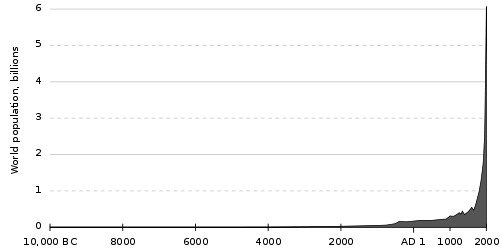
During most of human history, world population grew very slowly. On average a woman during her short life got 6 children of whom 2 survived to adulthood. This has changed as healthcare and food supply has improved. From the 18th century global population growth accelerated, with shortening doubling times, 1 billion in 1800, 2 billion in 1927, 4 billion in 1974 and 7 billion in 2011. However, since the early 1990s the rate of increase is diminishing and growth is expected to end by about 2050 at a world population of about 9 billion
Will the resources of the world be sufficient for 9 or so billion inhabitants? Is the carrying capacity enough? Most researchers believe that enough food for all will be possible. One will however have to decrease food loss, and improve agricultural productivity in many areas, not the least in Africa. However, we see land prices increase steeply in many parts of the world as an indication that the food production issue is expected to be critical.
In individual parts of the world, this development from a small population to exponential growth to finally levelling off at a higher level has already taken place. It is called the population transition. It begins when health improves, life expectancy increases and birth rate dramatically decreases. After some time, family size will shrink. An important reason for this is decreasing child mortality. It will thus not be necessary to have many children to be taken care of at an older age; as children go to school, they are also more a cost than a help in the household; and finally that families choose to have fewer children for improving their own lives. Of course, basic family planning has to be available to make these changes possible. These insights also point to what is needed to curb population growth.
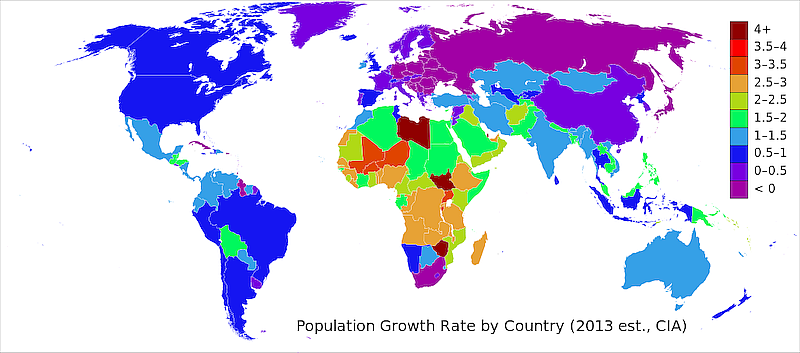
A generation or two ago the so-called developing countries had many children per woman often about 6, and a population growth approaching 3%, while in developed, industrialized countries the figure was closer to 2.1 children, which is the replacement rate. Since then, a dramatic change has taken place. Especially in Asia, birth rates of many countries have dramatically decreased. High birth rates today only remain in Africa. In all of Europe the birth rates are lower than replacement rates and in some countries much lower, e.g. in Southern Europe. In Central and Eastern Europe, population decline is typical, both because of low birth rates and emigration.
An effect of improved health status of the population is that life expectancy is increasing. Life expectancy at birth globally was 68.3 years in 2010, but there are large regional differences. Highest is Japan with 82.6 years, while in many African countries the value is around 40 years. In Sweden in 2011 life expectancy at birth was 83.7 for women and 79.8 for men. Life expectancy is increasing with about 3 months per year in Europe, mostly because mortality at higher age is decreasing. If this development continues, living to 100 years of age will be common in the near future.
As a sustainable society in the long term cannot have a steadily increasing population, we will have an ageing society. A much larger share of the population will be retired, and a common heard concern is that fewer (in working age) will have to support many more (retired). Another concern is that costs for elderly care will increase dramatically. Very few countries have developed a policy to manage this question. Rather, many countries try to decrease average age by stimulating families to have more children or immigration. However, this is only to postpone the problem, which will reappear but at a much higher total population.
When state guaranteed pensions were introduced the retirement age was equal to average life expectancy, that is, pensions were not a large cost for the country. Today, the pension age is debated. We see proposals to increase the age of retirement coupled with efforts to encourage elderly to stay at their working places voluntarily, often on part-time and with less heavy jobs. But there may also be voluntary contributions in many sectors of society by elderly who has a considerable experience in helping young people. Examples include business angels, elderly business leaders helping younger to get started. We have also seen healthy elderly taking care of less healthy elderly. It should in addition be said that according to macroeconomic modelling the average working hours in a sustainable economy should decrease substantially compared to the norm today, the 40-hour week. In a more sustainable society, it may be enough that a smaller section of society is working.
Materials for session 8a
Basic level
- Watch Hans Rosling on Global Population Growth (YouTube film).
- Watch Hans Rosling: New Insights on Poverty and Life Around the World (YouTube film).
- Read EHSA, book 3, chapter 8: Demographic Development in the Baltic Sea Region.
- The Demographic Transition by Keith Montgomery, University of Wisconsin.
Medium level (widening)
- Read Baltic Sea Region, chapter 39, pages 495-509: Populations Around the Baltic Sea.
- Ageing of Population by Leonid A. Gavrilov and Patrick Heuveline.
Advanced level (deepening)
- Examine how your country is preparing for an ageing society. As examples, two documents are given:
For Sweden from the Swedish Institute.
For Poland from Ewa Fratczak Warsaw School of Economics.
References
Maciejewski, W. (ed.) 2002. The Baltic Sea Region – Cultures, Politics, Societies. Uppsala. Baltic University Press.