
Lesson 9c
Making and implementing sustainable development politics
Social problems do not appear on the political agenda until they are perceived as social problems by the policymakers. Actors who want changes in society have to introduce their concerns on the agenda. Sustainable development was introduced as a political concern after the raising environmental movement in the 1960s, followed by the Stockholm conference in 1972 and finally the Brundtland Committee Report Our Common Future in 1987. After the Rio UNCED conference, it was established on the agenda all over the world.
Many factors influence politicians when they make political decisions. These include their ideology on how to develop their country. There are pressure groups, which do their best to influence the politicians, and there are also business interests, budget limitations, and not the least concern about the voters. Politics that will severely decrease the odds to be re-elected have small chances. One may argue that it is not the politicians, which lead the development of society – the voters have to be ahead. Politics leading towards a transition to a sustainable society will, according to this view, start from below.
Politics is implemented as governments, parliaments and local authorities decide on new laws and regulations and economic measures such as taxes or subsidies (which are a kind of regulations). The decisions are implemented by authorities, among them Environmental Protection Agencies, Energy Agencies etc, which are given the administrative, financial and legal resources needed. Authorities work though information, legal regulations and economic subsidies or taxation. The implementation of politics is monitored by the authorities and in the final stage, if it is not followed, the police and court system will deal with this.
Different political parties and interest groups choose different strategies for sustainable development. Neoliberal groups argue for business as usual and that the market forces will take care of it, e.g. the price of oil will increase as oil becomes scarce, and then renewable energy will be competitive. Others argue that human ingenuity always solved problems when confronted with the necessity to do so. This technological optimism leaves the problem to the engineers. Those promoting green business as the solution argue for ecological modernization as the answer to the sustainability challenge. Another group asks for responsible policies and respect for ethics and values. All experience shows that none of these strategies will lead to sustainable development by themselves, but that all of them will contribute to an extent. One may see sustainable development as a strategy in itself with its own methods (See further Session 11a) or subdivide the main types of strategies mentioned above into detailed measures.
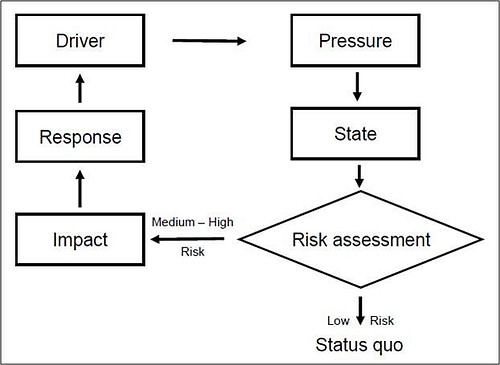
The European Environment Agency uses a formalized description of the process in which an environmental concern appears and enters the political agenda, a process that may be generalized for the more general sustainability issues. The process is known as the Driver-Pressure-State-Impact-Response (DPSIR) framework. Driver is the activity which leads to an impact, such as an industrial process; Pressure is the consequence of that activity such as a pollutant released into water or air; State is the condition it leads to e.g. an increased concentration of a pollutant in the environment: Impact is the consequence for example sick people or disappearance of a species; Response is what the authorities do to improve the state of the environment or society. This sequence of events should be followed by an evaluation and possibly planning for a new round of steps.
In a study on the success of sustainable development work in European cities, it was clear that the most successful local authorities had implemented clear work strategies. First, it was crucial that the head of the city administration as well as the politicians were concerned about sustainable development, so the whole organization had a strong support from the leadership. Secondly, there was more integration between the different departments of the city administration not only in the environmental side but also between economic and planning departments, that is, they used integrated sustainability management. Thirdly, the successful cities more than the others had an active policy for learning, that is, they had implemented institutional learning, as a crucial work strategy. This requires coordination and planning; it is not enough that a few specialists are aware of the background and reason for work.
Materials for session 9c
Basic level
- Study policymaking in Environmental Science, chapter 22 (pdf), especially pages 665-669: Making and Implementing Environmental Policy,
- Study the policy-makers in Environmental Science, chapter 22 (pdf), especially pages 670-675: Making and Implementing Environmental Policy,
- Study implementation of policies in Environmental Science, chapter 22 (pdf), especially pages 676-687: Making and Implementing Environmental Policy.
Medium level (widening)
- Study sustainable development strategies in National Strategies for Sustainable Development: Challenges, Approaches and Innovations in Strategic and Coordinated Action by International Institute for Sustainable Development, pp. 1-44.
- Study the DPSIR framework for working with impacts on society. For example, at this link.
Advanced level (deepening)
- Study institutional learning in Organisational and Institutional Learning in the Humanitarian Sector from ALNAP, Active Learning Network
References
Rydén, L., Migula, P. and M. Andersson (eds.). 2003. Environmental Science – understanding, protecting and managing the environment in the Baltic Sea region. Baltic University Press, Uppsala.