
Lesson 11C
Managing change
Is it possible to stimulate, help and even manage the process of change to a more sustainable society? In this sub session we will examine the methods, which exist to move individuals, groups, or organizations or even whole societies from the existing state into a desired, future state. Part of this has to do with how to influence individuals and groups to change, part is an organized work at a company or local authority, and finally a part is closer to policymaking.
For an organization, such as a company or a local authority, it is important that the leadership supports a change process if it should occur at all. In a study on the success of sustainable development in European cities, it was clear that the most successful local authorities had implemented clear work strategies. First, it is crucial that the head of the city administration as well as the politicians were concerned about sustainable development, so the entire organization had strong support from the leadership. The same is true for companies.
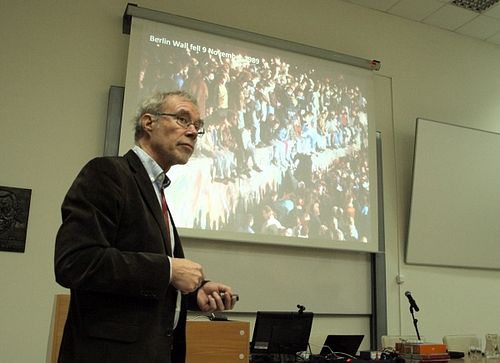
Education and learning is also part of a successful change process. This is true at all levels, including individuals and cities. The successful cities more than the others had an active policy for learning, that is, they had implemented institutional learning, as a crucial work strategy. This requires coordination and planning; it is not enough that a few specialists are aware of the background and reason for change.
Change management when implemented becomes project work, with all the classical components of successful project management, including monitoring, innovations, follow up and evaluation, and new management cycles. The first to describe this systematically was the American W. Edwards Deming, who in the 1950s described management cycles with four stages: plan-do-check-act. In a systematic development work, such cycles are repeated regularly, often each 3rd or 2nd year. As in all such processes the monitoring is important and indicators have to be identified, goals or targets for the process have to be set, and back-casting may be used to define partial goals in a long-term development.
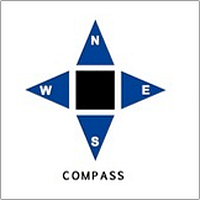
The system to be managed, it may be a company or a city, is identified using a frame, that is, one need to frame the system or structure it in a clear way. The best known frame is the environmental, economic and social “dimensions” of a system. This is much used in business and then referred to as the triple bottom line. A better frame is the compass used in the ISIS method, where North is (Nature), South (Society), East (Economy) and West (Wellbeing). Here the social part is divided in one set referring to the people and another for society, e.g. institutions. It is possible to frame systems in several other ways (See further urban development Session 4c). Other well-known frames are the five capitals introduced by Jonathan Porrit in the UK, and the resource approach used in city development, e.g. in Habitat. The framing of the system helps to include different parts, e.g. of a city or company administration, not only the environmental side but as well economic and planning departments, that is, to use integrated sustainability management.
Among general methods for managing a change process to increase sustainability in a company, a city, or even a country, the most important may be Alan AtKisson’s ISIS method. The core of the ISIS process is Indicators, System, Innovations, and Strategies. The full process consists of 9 consecutive steps, in short Systems understanding; Sustainability understanding; Development vs. growth; Indicators; Systems Analysis; Innovation; Strategy; Agreements and Actions; and Strategic Evaluation.
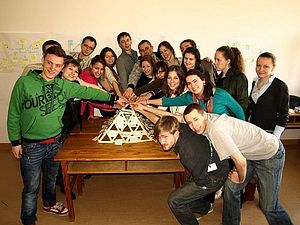
The procedure is used in so-called pyramid workshops, where the participants work together for learning about and designing change in a system. The workshop consists of building a pyramid of four sides and five layers. The layers correspond to the steps in the ISIS methods, the four sides to the frames of the system using the compass.
Another well-known method for managing a change to increased sustainability has been worked out by the Natural Step Foundation. The basis of the method are the four so-called systems conditions (See session 1b), developed at Chalmers University of Technology in the early 1990s. Ways to fulfil the system conditions are worked out and a plan for how to proceed. Back-casting is made to identify partial goals in the project.
Individuals are very different when it comes to their capacity, interest, or possibilities to change. Alan Atkisson in his Amoeba game differentiates between several types of personalities in relation to change, from enthusiasts to those who are very resistant. Reactionaries are very sceptical to all kinds of changes, laggards are slow to change and do not want to get involved. Mainstreamers constitute the biggest group in most situations and come after those who set the path. The key individuals when it comes to change are the change agents, the forerunners. Transformers are able to implement change, often authorities. He also points to a number of other less common personalities, such as innovators more concerned about their own ideas, but still very important, and others who are just a nuisance.
There are various ways to try to inspire and influence a person or a group to change. Scott Geller has examined successful change processes. His model of actively caring includes three factors: 1) self-esteem – I am valuable, 2) empowerment and optimism – I can make a difference, and 3) belonging and ownership – I belong to a group. These factors may induce individuals to choose a new lifestyle. They may also make people actively recruit others to a new lifestyle, that is, to become change agents and help them to influence others to become involved.
Materials for session 11c
Basic level
- Study behaviour change theories in the Environmental Science, chapter 21, especially pp 651-658: Behaviour and the Environment
- The ISIS Accelerator tools.
- A Brief Overview of The Natural Step.
Medium level (widening)
- Study institutional learning in Organisational and Institutional Learning in the Humanitarian Sector from ALNAP, Active Learning Network
- Welcome to Changing Minds.org the largest site in the world on all aspects of how we change what others think, believe, feel and do. There are already around 5000 pages here, all free and with much more to come.
Advanced level (deepening)
- The ISIS Method A Handbook for Sustainability Practitioners.
- Our Approach – The Natural Step Framework.
- The natural step Sustainability Distance Learning.
References
Atkisson, A. 2010. The Sustainability Transformation – How to Accelerate Positive Change in Challenging Times. Routledge, UK.
Rydén, L., Migula, P. and M. Andersson (eds). 2003. Environmental Science – understanding, protecting and managing the environment in the Baltic Sea region. Baltic University Press. Uppsala, Sweden.