
Lesson 5c
Waste – sustainable end-of-life of products
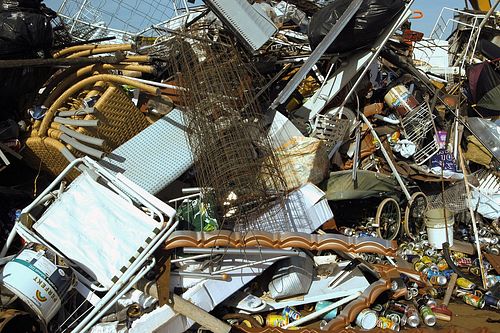
In the 1970s countries in Europe became alarmed by rapidly growing piles of waste. Landfills were expanding in many countries both by household waste and waste from industries. This was propelled by non-recyclable products from bars, kitchens etc. as well as the increasing number of packages used for all kinds of products in the shops. More than 50% of household solid waste consisted of packages. In the European Union the amounts of household waste is despite efforts over many years still increasing. It is now approaching 600 kg per year and capita.
Even worse is the too common habit of illegal dumping of waste, e.g. along the roads increasing with increasing costs. In addition to being ugly, it pollutes – sometimes seriously e.g. lead or mercury from old batteries – and threatens wildlife. A particular bad habit is to dump waste from ships right into the sea. The sea cannot accommodate all the waste from boats, and many times the waste turns into deadly traps for sea animals, such as seals. Especially plastic is serious since most of the plastic ever produced, non-degradable, is still there and pollutes. In the Pacific Ocean currents have concentrated plastic debris to a huge area called the Trash Vortex.
The costs of the growing piles of garbage and landfills mounted due to increasing land use and other resources being used up. Also landfills were environmentally problematic since they leaked to groundwater and emitted methane, a strong climate gas. For these reasons environmental legislation attempted to limit waste amounts and taxed waste sent to landfill.
An even more important aspect is that waste on landfills is a sign that the resource flow is linear, and therefore completely unsustainable and in fact a symptom of badly designed production and consumption patterns. In general the material flows in Europe were in the 1990s overwhelmingly, more than 95%, linear and going from resources to production, and use to waste.
The largest waste categories are mining and industrial waste. The management of this waste is discussed at Chapter 5a. The most sustainable option is industrial symbiosis when waste is used as a resource. Some wastes are used for building infrastructure (e.g. roads) while agricultural waste may be used for energy purposes. Construction waste is a special case since it is such a large waste category. Costs of waste have spurred building companies to be more inventive to reduce this waste category considerably.
In this sub-session we will mostly address household waste even if many of the options are also valid for industrial and agricultural waste. Another specification is that below we will deal almost exclusively with solid waste. Emissions to water and air, which also may be included in waste, will not be discussed here. There are several ways to deal with the increasing amounts of waste. Below we will summarize the most important ones. These measures should be seen in the contexts of product design (See Chapter 5b) as well as production (See Chapter 5a).
The European Union has listed the different options to deal with waste into a waste hierarchy going from best to worst:
Reduce, or waste reduction, reducing the product flow
Reuse, make products more repairable and with longer lives, or give to next user
Recycle, this most often refers to the materials in the products
Composing, for organic waste, the resulting compost may be used
Fermentation to biogas, also an option for organic waste, and biogas used for energy
Incineration, organic waste may be burned and heat taken care of, e.g. in district heating
Incineration, without recovery of the heat produced
Landfill
The most important way to deal with waste is recycling. Either to recycle the products themselves or the material they consist of. Recycling may be either internal or external.
Internal recycling is when in a factory the material discarded in a product step is taken care of and, often after some kind of processing, fed back into the production chain. This is a very important part of Cleaner Production strategies and has reduced waste from industries and increased efficiency considerably.
External recycling, or open loop recycling, is when the material is coming back to the production chain after having been used. A typical case is paper, which is sent back from the consumers after e.g. the newspaper has been used and read. The old paper is then washed to take away ink from printing and used for new paper products. Theoretically a cellulosic fibre can be recycled 6 times before it is too short to be useable for paper. Then it is sent to incineration. This process is also called downcycling, as the quality of the material decreases at each cycle.
Recycling is never perfect but in some cases they may be close to 100%. Thus recycling of lead-containing car batteries is very well organized in some countries to make such a technical recycling loop close enough to perfect to allow the use of the quite toxic lead in society. We would like to see the equally perfect recycling of all kinds of batteries but this is not yet the case.
Recycling of household waste ask for a good waste sorting already in the households themselves. Good household sorting gives 6 basic fractions (compostable, burnable, paper and cardboard, plastics, metal, glass). Of course this has to be followed by proper processing at the later stages, which is not always in place. In addition special waste, such as batteries, light bulbs etc has to be managed in addition to the six categories mentioned.
The many toxic components in different kinds of ordinary household equipments have prompted the European Union and other countries to introduce strict legal requirements on waste management of many products. Best known may be the Waste Electrical and Electronic Equipment, WEE, Directive. This prescribes how to properly take care of all kinds of electrical and electronic equipment, such as computers, refrigerators etc. It puts large responsibilities on the responsible authorities most often the municipalities. This is however only a small part of the whole. The European strategy for prevention and recycling of waste is one of the presently seven environmental themes in the EU and is backed by the Waste Framework Directive, which includes a long list of special directives.
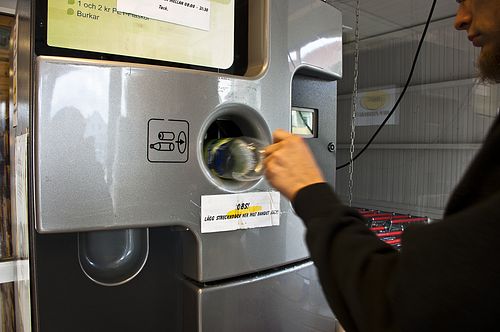
Recycling is also backed up by economic incentives, most importantly the deposit and refunding system. In this system the customer when buying a beverage pays an amount of money for the bottle or can. He/she is then refunded when the empty bottle or can is returned. In this way more than 90% of aluminium cans in Sweden are recycled.
Increasingly often the producers also are legally required to take care of the wasted products. This is called Extended Producer Responsibility, EPR. In many countries it applies to a large number of electric and electronic products, large equipments such as cars, and equipments with some toxicity, e.g. light bulbs.
Some waste can be bought and sold, that is, it has a market value. Thus scrap metal is quite valuable on the market, and sometimes scrap plastic is also sold. Quite expensive is scrap copper. Also some bio-waste is sold and bought, e.g. forest residues. More recently other products have entered the market, such as used car tires. Of course any kind of used items (cars, furniture etc), which are offered on a market belong to this category, and some municipalities make considerable efforts to make this second-hand market functional. In the waste hierarchy it belongs to reuse.
Recycling reduces the material flows, but also improves energy management as the waste stream includes a considerable amount of energy. This is particularly clear for metals: to produce a metal object from scrap metal rather than from the virgin ore is much less energy requiring. Thus to use scrap iron consumes 6 times less energy, scrap copper 30 times less and aluminium 50 times less energy compared to virgin ore. To use recycled paper instead of fibres from wood uses about 6 times less energy. It is obvious in all cases that virgin resources are saved, for example many trees in the case of paper production. Likewise waste to energy is important: Solid waste is incinerated and the heat used for district heating and coproduction of electricity; compostable waste is fermented to give biogas for energy purposes (See Chapter 2a).
Developments: during the last decade in EU the number of landfills has decreased and those remaining are strictly regulated and are subject to the IPPC Directive (Integrated Pollution Prevention and Control). Instead waste stream are managed according to increasingly more careful legal control. Recycling is increasing and material which cannot be recycled are more often sent to waste incineration in power plants for energy recovery. Still, amounts of household solid waste per capita continue to increase.
Materials for session 5c
Basic level
- Read Environmental Science, chapter 18 (pdf), pages 551-555: Solid Waste.
- Read Environmental Science, chapter 18 (pdf), pages 556-558: Solid Waste Management.
- Read Environmental Management, book 3, chapter 10 (pdf): Waste Management and Product Design.
- Read Environmental Management, book 2, chapter 10 (pdf): Waste Reduction.
Medium level (widening)
- Read Environmental Science, chapter 18 (pdf), pages 558-562: Soil Protection and Solid Waste Management.
- Read Environmental Management, Book 1 (pdf), pages 208-209, part B: European Union Environmental Legislation.
- Read Environmental Management, Book 1 (pdf), pages 211-212, part B: European Union Environmental Legislation.
Advanced level (deepening)
- Study Environmental Management, book 4, case 1 (pdf): Kunda Nordic Tsement.
- Study some cases which use the C2C (Cradle to Cradle) approach, e.g. McDonough Braungart Design Chemistry MBDC.
References
Klemmensen, B., Pedersen, S., Dirckinck-Holmfeld, K.R., Marklund, A. and L. Rydén. 2007. Environmental Policy – Legal and Economic Instruments. Book 1 in a series on Environmental Management. Baltic University Press, Uppsala.
Nilsson, L., Persson, P. O., Rydén, L., Darozhka, S. and A. Zaliauskiene. 2007. Cleaner Production – Technologies and Tools for Resource Efficient Production Book 2 in a series on Environmental Management. Baltic University Press, Uppsala.
Rydén. L., Migula, P and M. Andersson. 2003. Environmental Science – understanding, protecting, and managing the environment in the Baltic Sea region. Baltic University Press. Uppsala, Sweden.
Weiß, P. and J. Bentlage. 2006. Environmental Management Systems and Certification. Book 4 in a series on Environmental Management. Baltic University Press, Uppsala.
Zbicinski, I., Stavenuiter, J., Kozlowska, B. and H.P.M. van de Coevering. 2006. Product Design and Life Cycle Assessment. Book 3 in a series on Environmental Management. Baltic University Press, Uppsala.
BUP Sustainable Development Course