
Lesson 4c
Urban sustainability policies, strategies and management systems

In the Agenda 21 document from the Rio UNCED 1992 Conference the local perspective is considered essential to achieve sustainability. On this basis local authorities all over the world were encouraged to set up long-term action plans for sustainable development, the so-called Local Agenda 21 (LA21). Such action plans were adopted by thousands of local authorities around the world in the following years. Today 6400 municipalities in 113 countries have done so.
A number of organisations were created to support the local sustainability work. ICLEI, Local Governments for Sustainability, was formed in 1990 as the ‘International Council for Local Environmental Initiatives’, presently with 1220 local government members. Within the European Union The Sustainable Cities and Towns Campaignwas founded in 1994 as an umbrella organisation of associations of local authorities working with sustainability issues. It is supported bythe European Commission and has an office in Brussels. Through its member organisations, such as ICLEI, more than 2500 local and region governments with more than 500 million inhabitants are included in the Campaign. In the Baltic Sea region the Union of Baltic Cities, UBC, with 106 member cities is a key actor.
Among the policy documents for local sustainability work Chapter 28 in Agenda 21 forms the base. Soon after the Rio conference the Aalborg charter was written as a founding statement for the European Sustainable Cities and Towns campaign. It includes commitments in 10 areas to be signed by members. On the global scale the United Nations Human Settlements Programme, UN-HABITAT, was established in 1978 by the UN General Assembly to promote socially and environmentally sustainable towns and cities with the goal of providing adequate shelter for all. At the Habitat II conference in Istanbul, Turkey, 1996 171 countries adopted the Habitat Agenda with over 100 commitments and 600 recommendations.
Within the European Union a main actor is CEMR, the Council of European Municipalities & Regions. CEMR has within EU the same legal status as the European Parliament and thus may influence all decision in the Union. The European Union adopted in 2006 a thematic strategy on the urban environment to contribute to a better implementation of existing EU environment policies and legislation. The strategy encourages local authorities to adopt a more integrated approach to urban management.
Each local authority, large or small, has an administration to execute its duty as authority but also to plan and often carry out the development of the city. Local sustainability work requires a considerable independence. The economic and legal competence of the local authorities varies enormously. Nordic municipalities have much independence, as they collect local taxes as well as charges (for water, waste etc) and have many duties, such as education, healthcare and local services. In other countries many of these duties belong to the state level. All municipalities typically have a planning monopoly. Thus urban planning is always made locally.
Which strategies have cities adopted to achieve sustainable development? This varies considerably. Typically we see the same as in production and consumption. Thus reduce resource use, replace non-sustainable resources such as oil, and re-scale e.g. up-scaling by introducing district heating or down-scaling by using local resources. However integrating and recycling, e.g. by using organic waste for biogas production and using biogas for buses in the public transport system, is a very efficient measure. More advanced cities create self-reliant neighbourhoods, develop public transport considerably, and improve the urban/rural interface.

Management refers to how a strategy is implemented, which steps are made to realize projects. Management systems are typically set up as a series of management cycles, often 3 years long, based on the Deming cycle, Plan-Do-Check-Act, which puts emphasis on continuous improvement. The many varieties of urban sustainability management include the Managing Urban Europe-25 initiative worked out by 25 European local and regional authorities during 2006-2008. It points out that political commitment is an essential, but too often weak component in the management cycles.
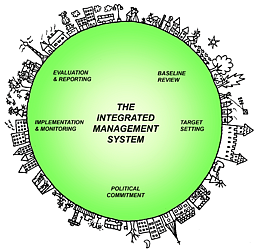
There are several management systems for local authorities. All systems ask for a series of indicators to be chosen, which should be continuously monitored over time and reported. Cities typically have tens to hundreds of indicators. They also ask for visions for the sustainability work. To establish what to achieve at the end of a specific management cycle, the target, one may do back-casting from the adopted vision to the present. It is possible for local authorities, just as it is for any organization, to use a standardized management system, such as EMAS or ISO 14001 to receive international certification according to the standard chosen.
In the management work the integrated approaches are essential. They are so far most common for the material turnover (water, energy and waste), although best would be if all aspects, including economic and social aspects, were included. A participatory system is asked for in the policy documents. This is partly required by law, but may be wider if cities encourage their inhabitants to take part in the sustainability work as widely as possible. In public-private partnerships also the business world contributes to city development.
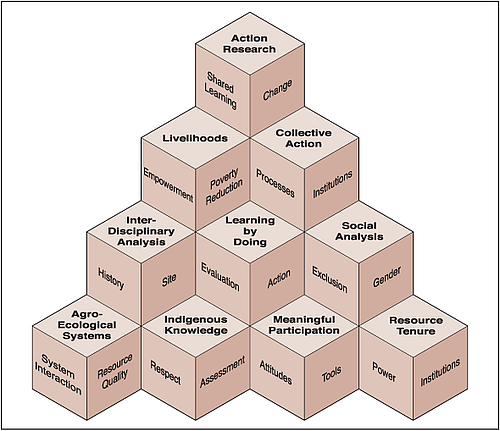
Building blocks of community-based natural resource management. http://www.idrc.ca/
Materials for session 4b
Basic level
- Read Environmental Science, chapter 25: The Prospect of Sustainable Development (pdf), page 786: Sustainable Urban Development
- Study Tools for Integrated Sustainability Management in Cities and Towns (pdf) by Lars Rydén.
- Read A Sustainable Baltic Region. session 7, chapter 6 (pdf), pages 37-40: Environmental Auditing and Management
- Read SUPERBS Case Studies Volume III: Public Participation and Democracy, chapter 1 (pdf), pages 4-14: Implementing Local Agenda 21 in the Baltic Sea Region by Björn Grönholm.
Medium level (widening)
- Read SUPERBS Case Studies, volume I, chapter 1: A Strong Municipality by Madeleine Granvik.
- Read SUPERBS Case Studies, volume I, chapter 2: Cultures of Municipal Administration (pdf) by Madeleine Granvik and Inger Christoferson.
- Read SUPERBS Case Studies, volume I, chapter 3: Urban Growth and Long Term Planning (pdf) by Madeleine Granvik and Mia Forsberg.
- Read Environmental Management, book 4, pages 241 – 250, Case Study 6: An ISO-certified System for Quality and Environmental Management in the Municipality of Nacka, Sweden. (pdf)
Advanced level (deepening)
- Read and compare: The Aalborg Charter and Aalborg committments.
- Read and compare the EU Thematic strategy on urban environment.
- Read and compare the UBC and the EUSBSR.
Additional Material
- Read the book SUPERBS Case Studies Volume IV: Urban Environmental Management
SUPERBS Case Studies, Volume IV, Chapter 1 (pdf): Municipal Environmental Audit – The UBC Manual as a Tool to Develop Local Environmental Management Applied in the Finnish Cities of Turku and Pori by Mikko Jokinen and Matti Lankiniemi.
SUPERBS Case Studies, Volume IV, Chapter 2 (pdf): Local Sustainability Indicators – The Development and Monitoring of Six Local Indicators in Kaunas by Linas Kliucininkas.
SUPERBS Case Studies, Volume IV, Chapter 3 (pdf): Waste Management and Nutrient Flows in the City of Turku – A Detailed N and P Flow Study to Estimate the Capacity of Biowaste Sorting to Contribute to Nutrient Recycling by Toni Tikkanen.
SUPERBS Case Studies Volume IV, Chapter 4 (pdf): Air Pollution and Damages to the Cultural Heritage in Cities – The Decay of the Cultural Heritage of Kraków by Wanda Wilczynska-Michalik.
SUPERBS Case Studies, Volume IV, Chapter 5 (pdf): Health Concerns in Environmental Management – The City of Kaunas’ Health Profile by Juozas Kameneckas.
SUPERBS Case Studies, Volume IV, Chapter 6 (pdf): Living in the 21st Century – The Ecological Community of Braamwisch by Silvia Schubert.
- Read the book SUPERBS Case Studies Volume III: Public Participation and Democracy.
SUPERBS Case Studies, Volume III, Chapter 1 (pdf): Implementing Local Agenda 21 in the Baltic Sea Region – The Case of Turku and Southwest Finland by Björn Grönholm.
SUPERBS Case Studies, Volume III, Chapter 2 (pdf): Livani – The Inhabitants as a Resource for Development by Visvaldis Gercans and Arnold Ubelis.
SUPERBS Case Studies, Volume III, Chapter 3 (pdf): Efforts to Create a Sustainable Economic Development in Livani by Visvaldis Gercans and Arnold Ubelis.
SUPERBS Case Studies, Volume III, Chapter 4 (pdf): Public Awareness and Public Participation as Elements in Strategies for Development by Arnold Ubelis.
SUPERBS Case Studies, Volume III, Chapter 5 (pdf): Urban Planning and Democracy in Post-Soviet Jelgava by Mara Urtane.
SUPERBS Case Studies, Volume III, Chapter 6 (pdf): Promoting Public Participation in Urban Planning by Mara Urtane.
SUPERBS Case Studies, Volume III, Chapter 7 (pdf): Democratic Development in Veliky Novgorod by Serguei Bessonov, Boris Shvedchikov and Denis Repkin.
References
Andersson, H. (ed.).1997. Cities and Communities. A Sustainable Baltic Region. Session 7. Baltic University Press, Uppsala.
Rydén, L. 2008. Tools for Integrated Sustainability Management in Cities and Towns. Baltic University Press, Uppsala.
Rydén, L. (ed.). 2002. Basic Patterns of Sustainability. SUPERBS Case Studies Volume I. Baltic University Press, Uppsala.
Rydén, L. (ed.). 2003. Public Participation and Democracy. SUPERBS Case Studies Volume III. Baltic University Press, Uppsala.
Rydén, L. (ed.). 2003. Urban Environmental Management. SUPERBS Case Studies Volume IV. Baltic University Press, Uppsala.
Rydén, L., Migula, P. and M. Andersson (eds). 2003. Environmental Science – understanding, protecting and managing the environment in the Baltic Sea region. Baltic University Press. Uppsala, Sweden.
Weiß, P. and J. Bentlage. 2006. Environmental Management Systems and Certification. Book 4 in a series on Environmental Management. Baltic University Press, Uppsala.
BUP Sustainable Development Course