
lesson 8b
Welfare
A sustainable society needs to secure human welfare. Welfare is very multidimensional and in addition different for each person, and it also depends on the society. Basic is security, health, and justice; to secure basic needs such as food; and access to education and work opportunities. Human welfare will be touched upon here and in several other sessions, in particular see also Chapter 8c, and Chapter 10b. Welfare is an important component of the social dimension of sustainable development. Here we will attempt to define what is included in basic needs and rights. This is not similar to resource flows and other physical and biological conditions, and we will have to rely on norms, that is ethics, as first principles, rather than laws of nature.
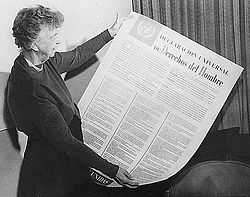
A first principle is the United Nations Universal Declaration of Human Rights, adopted by the UN General Assembly in 1948. The background was the atrocities carried out during the Second World War and the need for a document establishing which values that should not be violated regardless of circumstances. It is interesting to note that the Earth Charter (not yet adopted by the UN) can be seen as an extension of the Declaration, to encompass not only humans but also all other living beings and all Nature. The General Declaration of Human Rights have been followed by several other documents e.g. on children’s rights, workers’ rights etc. The UN system has thus played, and still plays, an important role in establishing a global ethics.
The Declaration includes a number of freedoms and rights, which had been included in different declarations since the American Declaration of independence of 1776 and French Revolution of 1789. These include religious freedom, political freedom (right of speech); to this was later added sexual freedom. There are also inscribed equal rights between genders, between different ethnic groups and rights for minorities. Each human individual should thus be respected and his/her integrity protected regardless of physical, ethnic or social belonging. The Declaration of Independence says “all men are created equal, that they are endowed by their Creator with certain inalienable rights, that among these are Life, Liberty, and the pursuit of Happiness”.
It is obvious that these rights have not been implemented fully in any state, although differences between states are large. Especially should be mentioned that minority rights are violated repeatedly as majority groups attempt to secure their own power and privileges, which in the worst case can lead to ethnic cleansing. Gender rights are violated in many cultures where it is not customary that women decide for themselves, for their future, choice of husband or profession, and violence against women are common.
The United Nations General Assembly adopted the International Covenant on Economic, Social and Cultural Rights (ICESCR) in 1966. The ICESCR, which went in force in 1976, commits its parties to work toward the granting of economic, social, and cultural rights (ESCR) to individuals, including labour rights and the right to health, the right to education, and the right to an adequate standard of living. In 2011, the Covenant had 160 parties. The covenant should be seen as a political agreement on basic duties of a modern welfare state and is thus different from the Declaration of Human Rights – which is perceived as a global ethics always valid regardless of circumstances – although it has a similar background.

In the declaration it is assured that each human has the right to safety and health, to education and possibilities to support themselves. These three parts of a human life – care when being child or elderly; education in childhood and young years; and work to have an income and livelihood – are the basic concerns for social security. A modern welfare state safeguards social security by social insurance programs and provides socials services in case of poverty, old age, disability, unemployment, and others. The means include retirement pensions, disability insurance, and unemployment insurance, to guarantee that each citizen has access to necessities such as food, clothing, housing as well as medical care and social work. The right to social security is recognized both in the Universal Declaration of Human Rights and the International Convent on Economic, Social and Cultural rights.
Not everyone can easily adjust to society. A certain percentage (estimated to be about 7% in some societies) suffer from minor or major physical, mental or social handicaps. Also, these individuals need to be taken care of. A smaller or sometimes larger sector of the population live their lives outside established norms. We have crimes; use of drugs, alcoholism; or simply individuals staying outside the established society. Each society has mechanisms to deal with these individuals; but again one should emphasize that also here basic human rights should be respected.
Materials for session 8b
Basic level
- History of Universal Human Rights up to WW2 by Moira Rayner.
- The Creation of the Universal Declaration of Human Rights by Peter Bailey.
- Universal Declaration of Human Rights.
- Read Baltic Sea Region, chapter 40 (pdf): Population and Living Standards.
- Read Baltic Sea Region, chapter 42 (pdf): Women and Gender in History in the Baltic Region.
Medium level (widening)
- Read Baltic Sea Region, chapter 44 (pdf): Work and Unemployment.
- Read EHSA, Book 3, chapter 9 (pdf): Economic Development and Work Opportunities in Rural BSR.
- Read Baltic Sea Region, chapter 45 (pdf): Use and Abuse of Tobacco, Alcohol and Narcotics – a Baltic Dilemma.
Advanced level (deepening)
- Examine how your country’s social security is organized.
References
Karlsson, I and L. Rydén (eds.). 2012. Rural Development and Land Use. Ecosystem Health and Sustainable Agriculture: Book 3. Baltic University Press. Uppsala.
Maciejewski, W. (ed.) 2002. The Baltic Sea Region – Cultures, Politics, Societies. Baltic University Press, Uppsala.